
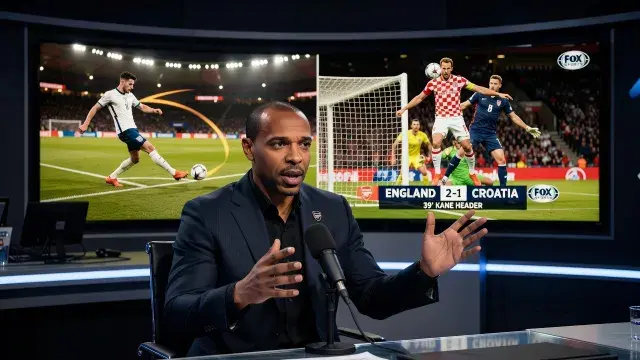
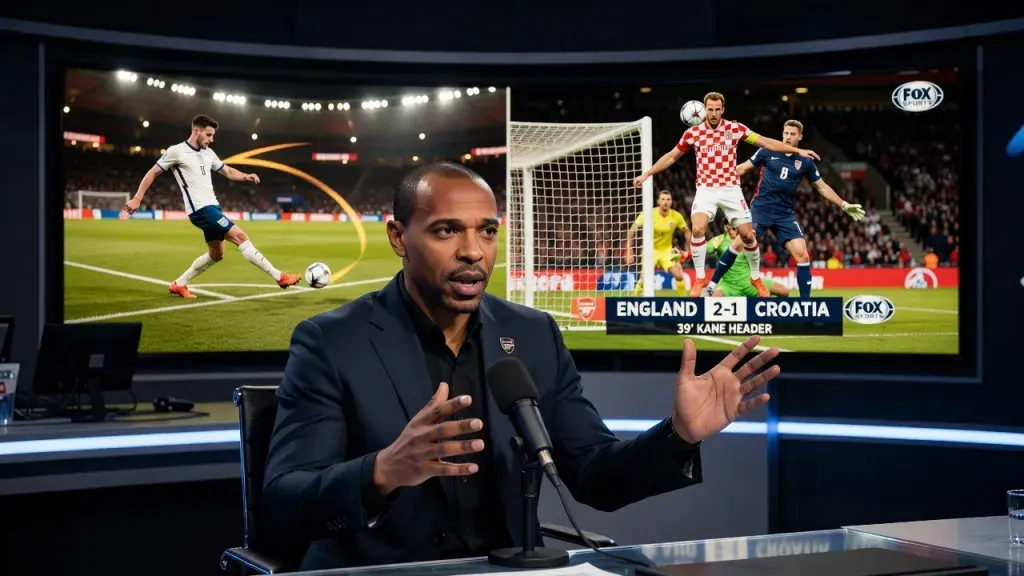
Thierry Henry did not waste time after England's 4-2 victory over Croatia in Group L to draw a pointed parallel with the controversy that has followed Arsenal through much of the 2025/26 Premier League season. The catalyst was straightforward: a Declan Rice corner from the right flank in the 39th minute, met by Harry Kane with a precise header to make it 2-1. It was a set-piece goal of the kind Mikel Arteta's side have made their signature - and Henry, watching on Fox Sports, was not about to let the moment pass quietly.
"That annoys many people when it comes to Arsenal. But when England do the same thing, everyone is happy to accept it," the former French striker said on air. The comment cut to the heart of a debate that has simmered in English football: whether Arsenal's reliance on dead-ball situations constitutes a genuine tactical virtue or an over-dependence on a single source of goals. Henry, who spent his most celebrated years at Highbury and the Emirates, clearly believes the criticism is applied selectively. It is worth noting that conversations about tactical innovation span multiple sports - much like how competitive strategy has evolved in areas as distinct as sapphire esports, where structured preparation and set routines have become just as decisive as individual brilliance.
Arsenal topped the Premier League's set-piece scoring charts this season, netting 26 goals from dead-ball situations - a figure that has drawn both admiration and criticism in roughly equal measure. Arteta's coaching staff have invested heavily in set-piece design, treating corners, free kicks and throw-ins as repeatable, coachable scoring opportunities rather than moments of fortune. The irony is that the same England players who have absorbed that methodology at club level - Rice being the most direct example - deployed it on an international stage to widespread approval.
England's Rocky Route to a Comfortable Scoreline
The 4-2 result flatters the overall picture of England's performance. Kane opened the scoring and doubled the advantage, but Croatia levelled on each occasion through Martin Baturina and Petar Musa, ensuring the Three Lions were far from comfortable heading into the break. It was a performance that will concern the coaching staff even as the three points go into the column. England conceded twice against a side they were expected to manage with more authority, and the defensive vulnerabilities exposed in the first half cannot simply be papered over by the comfortable winning margin.
The second half told a different story. Jude Bellingham, introduced with urgency, scored shortly after the restart to give England the lead for the third time. Marcus Rashford then sealed the result, converting to make it 4-2 and close out a victory that, on paper at least, looks convincing. For the group standings, the three points matter considerably. But the manner of the performance - the defensive lapses, the twice-surrendered lead - will attract scrutiny in the days ahead.
The Broader Debate Henry Has Reignited
Henry's remarks are worth taking seriously precisely because they come from someone who played at the highest level in England and understands the tactical culture of the Premier League from the inside. His point is not that set-piece goals are illegitimate - they are as valid as any other - but that the criticism levelled at Arsenal has been inconsistent and, in his view, unfair. When a club builds a systematic, repeatable structure around dead balls, it is called a crutch. When a national team does the same thing in a tournament, it is called smart football.
Arsenal's 26 set-piece goals this season represent genuine coaching innovation, not an accident of personnel. Rice, who was central to England's goal against Croatia, has been one of the key figures in Arteta's delivery structure. His ability to identify and exploit corners, particularly to the near and far post with measured pace, is a trained skill. The fact that it now functions for England as efficiently as it does for Arsenal rather reinforces Henry's argument than undermines it.
Whether the debate reshapes how pundits and supporters evaluate Arsenal's title-winning season remains to be seen. But Henry has ensured, at minimum, that the contradiction is on the record.


