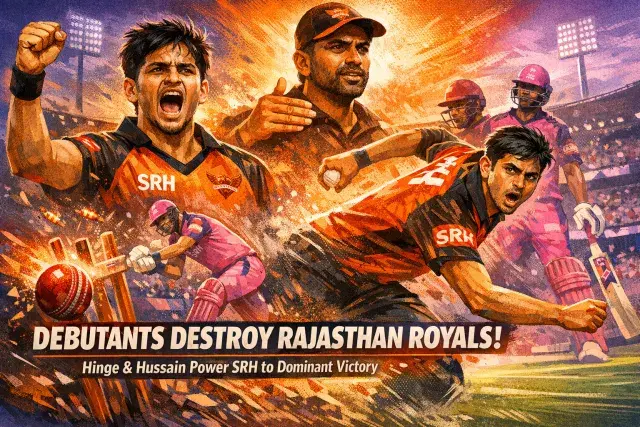

Four wickets apiece from Praful Hinge and Sakib Hussain — both appearing in their first IPL fixture — powered Sunrisers Hyderabad to a 57-run victory over Rajasthan Royals on April 14, as the experienced pace bowling guidance of Varun Aaron translated directly into results on the field. The performance was not merely a statistical outlier; it raised substantive questions about how preparation, psychological framing, and trust between mentors and young professionals shape high-pressure outcomes.
The Philosophy Behind the Preparation
Varun Aaron, the former India fast bowler now overseeing SRH's pace attack, offered a rare window into his mentoring approach after the fixture. His pre-match directive to both debutants was deliberately stripped of tactical pressure. "My only plan for them was to just enjoy the game because you debut only once in any format of cricket," Aaron told reporters. "My only plea before the game was that if I didn't see them enjoying it, I'd be really angry — and they truly did enjoy it."
This approach reflects a well-documented principle in performance psychology: reducing cognitive load under high-stakes conditions by removing outcome-focused thinking. When young professionals are freed from the weight of consequence and anchored instead in process and presence, fine motor execution — critical in precision-based disciplines — tends to remain intact. Aaron's framing was not passive; it was a deliberate psychological intervention.
Praful Hinge and a Moment of Historical Significance
Hinge's debut produced a statistical landmark. He took three wickets in his very first over of IPL cricket, making him the first bowler in the history of the competition to achieve three dismissals in the opening over of an innings. He finished with figures of 4 for 34 across his full allocation.
One dismissal carried particular weight. Aaron revealed that Hinge had expressed a preference to alter his line of approach to dismiss Vaibhav Sooryavanshi, a young batter who has drawn considerable attention this season. Aaron counselled restraint — "just stay over the wicket, I'm sure you'll get him out" — and Hinge held his conviction, ultimately taking the wicket on his own terms. "The plan was his, the conviction was his," Aaron said. That exchange illustrated something beyond tactics: a coaching dynamic built on collaborative trust rather than top-down instruction.
Sakib Hussain and the Value of the Impact Substitution
Sakib Hussain entered the fixture as an Impact Sub in place of Travis Head, a structural option the IPL introduced to allow a designated replacement who can bat or bowl without the usual constraint of replacing a player already involved in the innings. Hussain made immediate use of the opportunity, removing opener Yashasvi Jaiswal — one of the most technically accomplished young left-handed batters in the format — and then proceeded to dismantle the lower order, finishing with figures of 4 for 24.
The Impact Sub rule has generated considerable debate since its introduction, with critics arguing it distorts the traditional balance of the format and supporters contending it creates new pathways for specialist contributors. Hussain's performance on debut strengthens the case for the latter argument: a bowler with no previous IPL experience was able to enter at a decisive phase and shape the outcome of the fixture entirely.
What This Performance Reveals About Talent Development
SRH's victory — their second of the current season — matters beyond the result itself. Both Hinge and Hussain were specifically identified and advocated for by Aaron during the selection process, suggesting that the franchise has invested meaningfully in building a pipeline of pace talent rather than relying entirely on established names.
Rajasthan Royals, chasing a formidable 218-run target, were dismissed for 159 in 19 overs. The margin of 57 runs in a format known for its volatility is significant. It points to the execution of a coherent plan rather than opportunistic success. For young professionals entering any high-visibility, high-pressure environment for the first time, that combination — strong preparation, psychological freedom, tactical clarity, and institutional trust — is precisely what separates a promising debut from an unremarkable one.