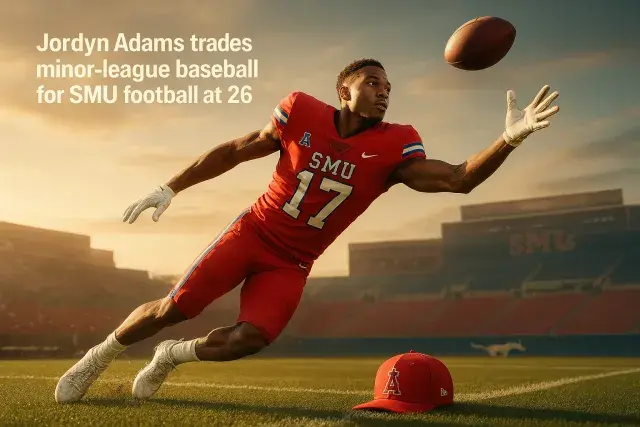

Jordyn Adams trades minor-league baseball for SMU football at 26
Jordyn Adams, a former Los Angeles Angels outfielder who ended his professional baseball career earlier this month, has signed with SMU to play wide receiver - entering college football for the first time at age 26. Adams never enrolled in college following his high school graduation in 2018, meaning his NCAA eligibility clock has not yet started under current rules.
Adams was among the top-rated wide receiver recruits in the 2018 class, a group that also included Ja'Marr Chase, and had committed to play both baseball and football at North Carolina. Those plans ended when the Los Angeles Angels selected him 17th overall in the 2018 MLB Draft and signed him to a substantial bonus. He spent the bulk of the following years working through the minor-league system, making his major-league debut in 2023. He appeared in 17 games that season and 11 more in 2024, finishing his MLB career with 13 hits across those appearances. He played his final minor-league game two weeks before this report.
The move follows a comparable path taken by Monte Harrison, a former MLB outfielder who joined Arkansas as a wide receiver after a decade in professional baseball. Adams, like Harrison, arrives with legitimate athletic credentials at the position - speed and ball-tracking ability developed over years as an outfielder translate directly to route running and contested catches at the college level, though his adjustment to contact and blocking assignments remains an open question.
The timing of Adams's enrollment carries procedural significance. The NCAA is weighing a proposed rule - referred to informally as the "5 in 5" framework - that would begin an athlete's eligibility clock at the point of high school graduation or upon turning 19, whichever comes first. Under current rules, Adams retains full eligibility because he never initiated it. SMU's decision to bring him in now suggests both parties moved with awareness of the potential regulatory change, though whether any revised rule would apply retroactively to Adams's specific circumstances has not been formally determined.