
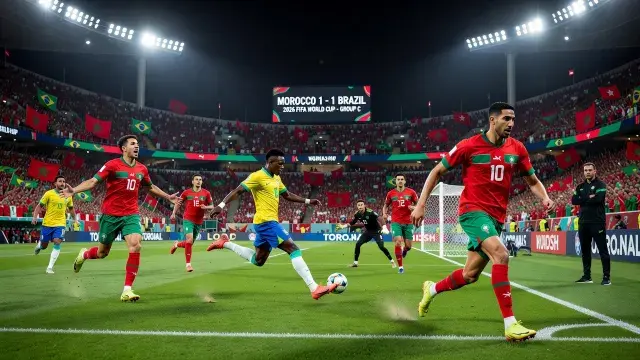
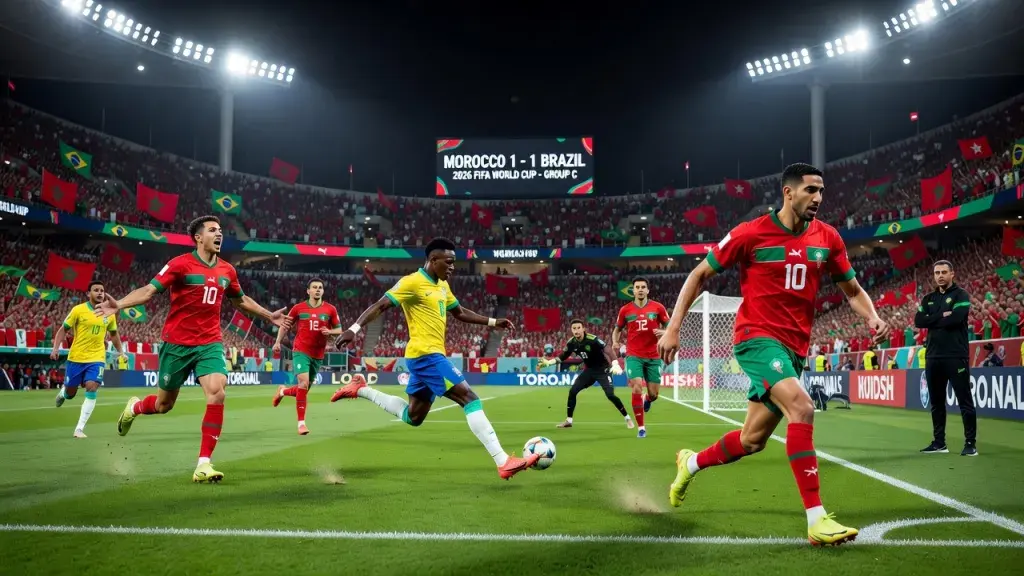
Anyone who has followed Moroccan football closely over the past four years would not have raised an eyebrow when the Atlas Lions walked away with a 1-1 draw against Brazil in their Group C opener at the 2026 FIFA World Cup. Morocco went ahead first, showing the same tactical discipline and collective purpose that stunned Europe in Qatar four years ago. It took a moment of individual brilliance from Vinicius Junior - arguably the most dangerous attacker on the planet - for Brazil to claw level. That, in itself, tells you everything about how far Morocco have come.
For supporters more accustomed to following mainstream European football or even niche disciplines like betting on floorball, the name Morocco might still carry the faint ring of an underdog. But within serious football circles, the Atlas Lions have long shed that label. Their 2022 World Cup campaign in Qatar was no accident - eliminating Belgium, Spain and Portugal on the way to a historic semi-final appearance announced Morocco as a genuine force. The 2026 edition confirms that status. This is a team built on structure, not fortune. betting on floorball
The Mohammed VI Academy: The Engine Behind the Revolution
The most important institution in Moroccan football is not a club or a federation committee - it is the Mohammed VI Football Academy, inaugurated by King Mohammed VI in 2009. What was conceived as a long-term development project has become one of the most respected football academies in the world, combining elite training with education, sports science and medical support under one roof. Players such as Youssef En-Nesyri and Nayef Aguerd passed through its programme before establishing themselves at the highest level of European club football. Several members of the 2022 World Cup squad that reached the semi-finals were academy products, and the institution's reach extended further when its trainees contributed to Morocco's triumph at the 2025 Under-20 World Cup in Chile.
Alongside the academy infrastructure, Morocco's decision to recruit players of Moroccan heritage from across Europe has been one of the federation's most consequential strategic moves. Achraf Hakimi developed at Real Madrid before becoming a world-class full-back at Paris Saint-Germain. Hakim Ziyech built his game at Ajax in the Netherlands. Noussair Mazraoui came through Bayern Munich's system. All three chose to represent Morocco rather than European nations, giving the Atlas Lions a talent pipeline that very few African countries can match.
Regragui's Blueprint: Discipline, Identity and Collective Belief
Head coach Walid Regragui has given Morocco something that transcends tactics: a clear identity. Under his management, the team plays with a defensive solidity that is difficult to break down, combined with sharp transitions and the technical quality to hurt opponents at pace. Against Brazil, those qualities were visible from the opening whistle. Morocco were not passive. They pressed, they competed for second balls and they took the lead - against a side that has produced more World Cup winners than any other nation.
Moroccan football culture reinforces what happens on the training pitch. Clubs such as Wydad AC and Raja Casablanca draw enormous crowds and sustain a domestic football environment that keeps young players hungry and motivated. The country's supporters - among the most vocal and passionate on the African continent - create an atmosphere that travels with the team to every tournament. That combination of institutional investment and cultural energy is what separates Morocco from nations that occasionally produce talented individuals without ever building a consistent programme around them.
The Stars Carrying Morocco's 2026 Challenge
Morocco's squad for 2026 blends the experienced core of the Qatar campaign with a new generation already making its mark. Captain Achraf Hakimi remains the team's most influential presence - an attacking right-back of genuine world-class quality whose pace, crossing and leadership are central to everything Morocco do going forward. Goalkeeper Yassine Bounou, known as Bono, made several important saves against Brazil and continues to be one of the most dependable goalkeepers in this tournament. Brahim Diaz, born in Spain and technically the most gifted attacker in the squad, poses a consistent creative threat that opposing defences cannot afford to ignore.
Two names have emerged from the Brazil match as the tournament's early breakout performers in the Moroccan ranks. Ismael Saibari Ben El Basra scored Morocco's goal and has become one of the most dangerous attacking midfielders in the group stage so far. Ayyoub Bouaddi, just 18 years old, produced a midfield display against Brazil that drew widespread attention and genuine admiration. His composure, range of passing and ability to handle the physical demands of a World Cup match at his age are markers of a player who will feature at this level for years to come. Azzedine Ounahi provides the tempo control and possession management that allows those around him to operate with freedom.
What India - and Others - Can Learn From the Atlas Lions
Morocco's journey carries a clear message for football nations that have struggled to convert potential into results - and India is one of them. The lesson is not simply about money or facilities, though both matter. It is about patience, institutional commitment and the willingness to build a programme that outlasts any single coach, federation president or golden generation of players. Morocco built an academy in 2009 and did not see its full results until 2022 and beyond. That timeline requires a level of planning and consistency that many football federations find difficult to sustain.
India has raw material - a population of over a billion people, a growing domestic league in the ISL and pockets of genuine footballing passion in states such as West Bengal, Goa and Kerala. What has been missing is a centralised, long-term development structure comparable to what Morocco built. The Mohammed VI Academy model - combining football training with education and sports science, feeding directly into the national team - is precisely the kind of blueprint Indian football administrators should be studying seriously. The co-hosting of the 2030 FIFA World Cup by Morocco alongside Spain and Portugal means investment in Moroccan football infrastructure will continue to grow. The gap between the two nations is wide today, but the direction of Morocco's journey shows that such gaps can be closed - with the right decisions made early enough.
For now, the Atlas Lions have announced themselves at the 2026 World Cup with a result that demands respect. Brazil did not lose, but they did not win either - and against Morocco in this form, that is a result their rivals across Group C will have noted carefully.


